Prasad Kavuri

Executive Capability Graph

AI Platform Capabilities

A high-signal capability map linking enterprise AI platform skills to concrete portfolio evidence. Use this page to evaluate platform leadership scope in one pass.

Enterprise Capability Lifecycle

How this platform turns knowledge into a governed capability

Enterprise AI maturity isn't about a single model or a single agent — it's about whether an organization can take what an expert knows, turn it into a governed, versioned, reusable capability, and safely run that capability at scale while it keeps improving itself. Every page under Platform in the nav implements one or more stages of this loop; this diagram is the map that connects them.
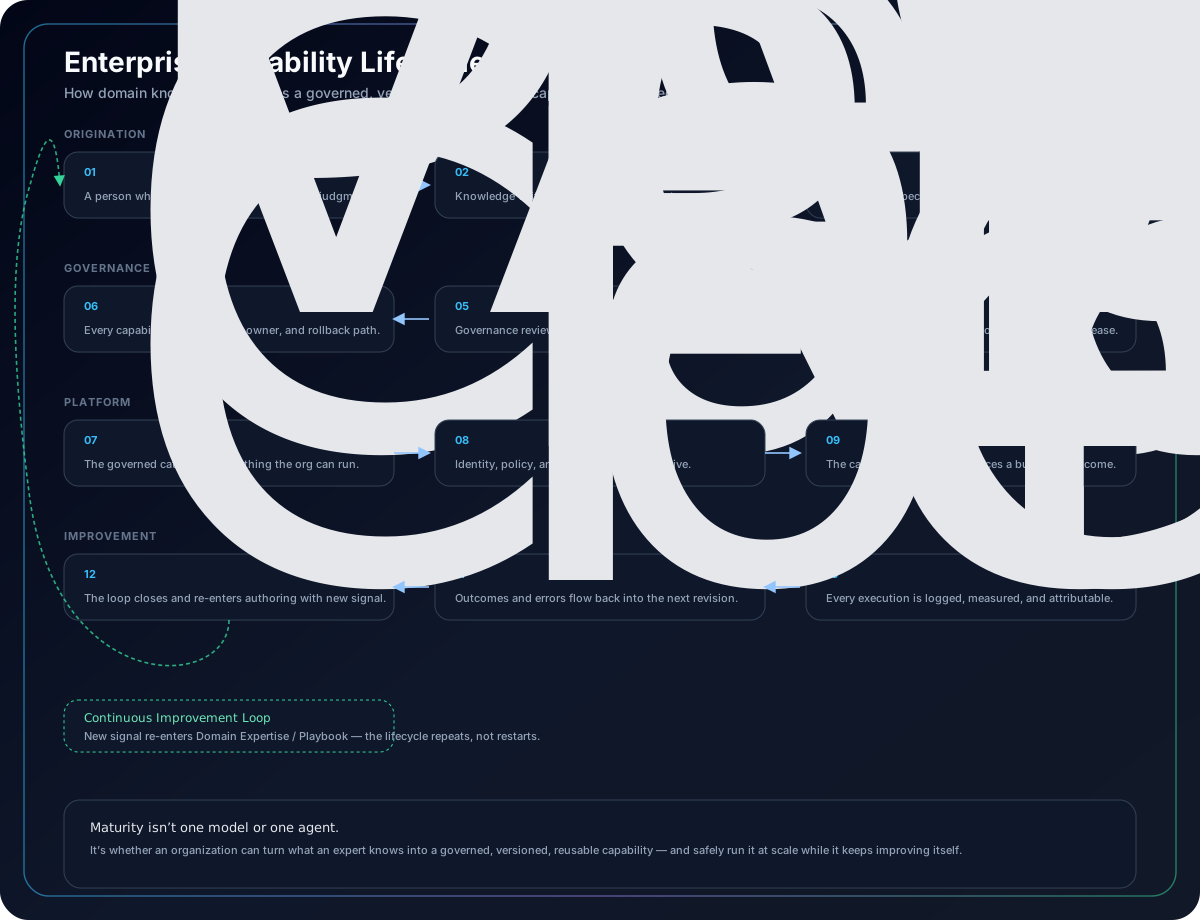
Enterprise Capability Lifecycle diagram: domain expertise, playbook, capability authoring, validation, approval, versioning, capability registry, runtime enforcement, execution, observability, feedback, and continuous improvement looping back to domain expertise.

Authoring & Registry — Skills Catalog

Versioning & Runtime — Enterprise Agent Runtime

Execution (inference layer) — AI Runtime Engineering

Validation & Approval — Adaptive AI Governance

Observability & Feedback — Governance Dashboard

Execution (live outcomes) — Agent Marketplace

Continuous Improvement — AI FinOps

Agentic AI Systems

Designs multi-agent workflows with explicit role boundaries, checkpoints, and deterministic execution paths.

Why it matters

Helps enterprises automate complex workflows without losing control, accountability, or release discipline.

Portfolio evidence

  • Multi-agent workflow demo with HITL checkpoint and approval gates
  • Agentic architecture patterns represented across demo and governance surfaces

Tool / MCP Orchestration

Implements tool-aware LLM patterns and MCP-style interaction models for structured agent-to-tool coordination.

Why it matters

Standardized tool orchestration reduces brittle custom integrations and improves operational reliability.

Portfolio evidence

  • MCP tool demo with explicit tool discovery and invocation flow
  • Recent MCP-focused certification signal in certifications hub

LLM Routing and Model Selection

Routes requests by complexity and constraints to balance quality, latency, and cost.

Why it matters

Enables cost-aware scaling while preserving response quality and reducing unnecessary premium-model spend.

Portfolio evidence

  • Live model routing demo with latency and cost comparisons
  • Routing rationale and business projection views for decision support

RAG and Knowledge Retrieval

Builds retrieval-augmented patterns combining semantic embeddings, retrieval ranking, and grounded response assembly.

Why it matters

Improves answer grounding and reduces unsupported outputs in enterprise knowledge workflows.

Portfolio evidence

  • Browser-native RAG pipeline with controlled fallback mode
  • Retrieval-focused demo path for grounded portfolio assistant behavior

Vector Search and Semantic Systems

Applies embedding-based semantic retrieval and ranking to improve discovery across unstructured information.

Why it matters

Turns natural-language intent into practical retrieval for support, operations, and decision workflows.

Portfolio evidence

  • Vector search demo with embedding visualization and ranked retrieval
  • Resilience patterns for degraded local-inference conditions

AI Governance and Human-in-the-Loop

Operationalizes guardrails, policy controls, and approval checkpoints for higher-risk AI actions.

Why it matters

Supports safe adoption by making governance enforceable, visible, and auditable in delivery workflows.

Portfolio evidence

  • Governance dashboard with controls, audit events, and trust flow
  • HITL checkpoints in multi-agent execution path

Observability, Reliability, and Fallbacks

Builds systems with runtime telemetry, resilience handling, and explicit degraded-mode behavior.

Why it matters

Improves production stability and user trust when models, backends, or dependencies fail.

Portfolio evidence

  • Evaluation and governance telemetry surfaces
  • Backend/init fallback and retry paths across browser-native demos

AI FinOps and Cost-Latency Optimization

Treats cost and latency as first-class platform constraints, not afterthoughts.

Why it matters

Improves AI unit economics and scaling feasibility for enterprise rollout.

Portfolio evidence

  • Routing economics and model tradeoff patterns in LLM router
  • Quantization benchmarking and model-size/performance comparisons

Platform Modernization

Connects AI capability delivery with cloud/platform transformation, reliability, and productization.

Why it matters

Accelerates movement from isolated pilots to reusable platform capability across business units.

Portfolio evidence

  • Architecture and transformation sections map system-level platform model
  • Cross-demo shared platform controls in the codebase and governance model

Executive AI Platform Leadership

Combines strategic leadership narrative with implementation-level depth across AI platform concerns.

Why it matters

Relevant for VP/Head/Senior Director hiring where outcomes require both org leadership and technical credibility.

Portfolio evidence

  • Recruiter-first summary path with executive metrics and guided review flow
  • Production-style portfolio with governance, evals, and operational controls